Time Signatures Explained: 4/4, 3/4 and 6/8 for Beginners
A time signature tells you how to count the music: the top number is how many beats are in each bar, and the bottom number is which note value gets one beat. So 4/4 means four quarter-note beats per bar, 3/4 means three, and 6/8 means six eighth notes grouped in two sets of three.
That's the whole rule, but it only clicks when you count it out loud. This guide walks through the three time signatures you'll meet first, gives you a famous public-domain tune for each, and ends with a two-minute clapping drill you can do anywhere. If you can't yet name the notes on the staff, start with the beginner's guide to reading sheet music, then come back here for the rhythm side.
Reading the two numbers
The time signature sits right after the clef and key signature at the start of a piece. It looks like a fraction without the line.
| Number | What it means | Common values |
|---|---|---|
| Top | How many beats in each bar | 2, 3, 4, 6 |
| Bottom | Which note gets one beat | 4 = quarter note, 8 = eighth note, 2 = half note |
The bottom number is a note value, not a count. A 4 means "quarter note" because a quarter note is a quarter of a whole note. An 8 means eighth note. You won't see 5 or 7 on the bottom, because there is no "fifth note".
Bar lines divide the music into bars (also called measures), and every bar adds up to exactly what the time signature says. That makes the time signature a checking tool: if a bar in 3/4 seems to hold four beats, you've misread a note value. Wikipedia's time signature article has a longer reference if you want to go further.
4/4: count to four
4/4 is called common time, and you'll sometimes see it written as a large C instead of numbers. Each bar has four quarter-note beats, with the strongest accent on beat one and a lighter one on beat three.
Count it like this:
ONE two three four | ONE two three four
When eighth notes appear, add "and" between the beats: ONE-and-two-and-three-and-four-and.
Example: Ode to Joy. The melody from the finale of Beethoven's Ninth Symphony moves in steady quarter notes, which makes it the classic first 4/4 tune. In the common C-major version, say "E E F G | G F E D" while tapping four even beats per bar, and you can feel how each bar fills up exactly.
3/4: the waltz
In 3/4 each bar has three quarter-note beats, with one strong beat followed by two light ones. That pattern is the swing of a waltz.
ONE two three | ONE two three
A useful image: a dancer steps down hard on ONE and glides through two and three.
Example: The Blue Danube. Johann Strauss II's waltz, from the 1860s, is pure 3/4. Hum the opening and tap only the ONE: you'll hit it once per bar, with two light beats in between.
6/8: two big beats, each split in three
6/8 is the one that confuses beginners, because it looks like "six beats". In practice you feel two main beats per bar, and each one is split into three eighth notes.
ONE two three FOUR five six | ONE two three FOUR five six
Say it fast and it starts to sound like a rocking or galloping pattern: DUM-da-da DUM-da-da. That lilt is why traditional jigs are usually written in 6/8.
Example: a jig. Any traditional Irish jig works. Listen for the bouncy DUM-da-da groups. If you count "one two three four five six" evenly with no accents, it sounds flat. Put the weight on 1 and 4, and it comes alive.
3/4 vs 6/8 side by side
These two hold the same number of eighth notes per bar, so they're easy to mix up. The grouping is what differs:
| 3/4 | 6/8 | |
|---|---|---|
| Eighth notes per bar | 6 | 6 |
| Grouping | 2 + 2 + 2 | 3 + 3 |
| Main beats you feel | 3 | 2 |
| Count | ONE-and-TWO-and-THREE-and | ONE-two-three-FOUR-five-six |
| Typical feel | Waltz | Jig, lullaby, rocking |
Look at the beaming in the score: in 6/8, eighth notes are usually joined in groups of three, which tells you the meter at a glance.
A 2-minute clapping drill
Do this with a metronome app at a slow tempo, around 60 to 70 beats per minute.
- 30 seconds of 4/4. Clap on ONE, tap your knee on two, three and four. Say the numbers out loud.
- 30 seconds of 3/4. Clap on ONE, tap on two and three. Notice how the clap comes around sooner.
- 30 seconds of 6/8. Set the metronome clicks to eighth notes. Clap on 1 and 4, tap on the rest.
- 30 seconds of switching. Do four bars of 3/4, then four bars of 6/8, without stopping the clicks. If you can switch cleanly, you've understood the difference.
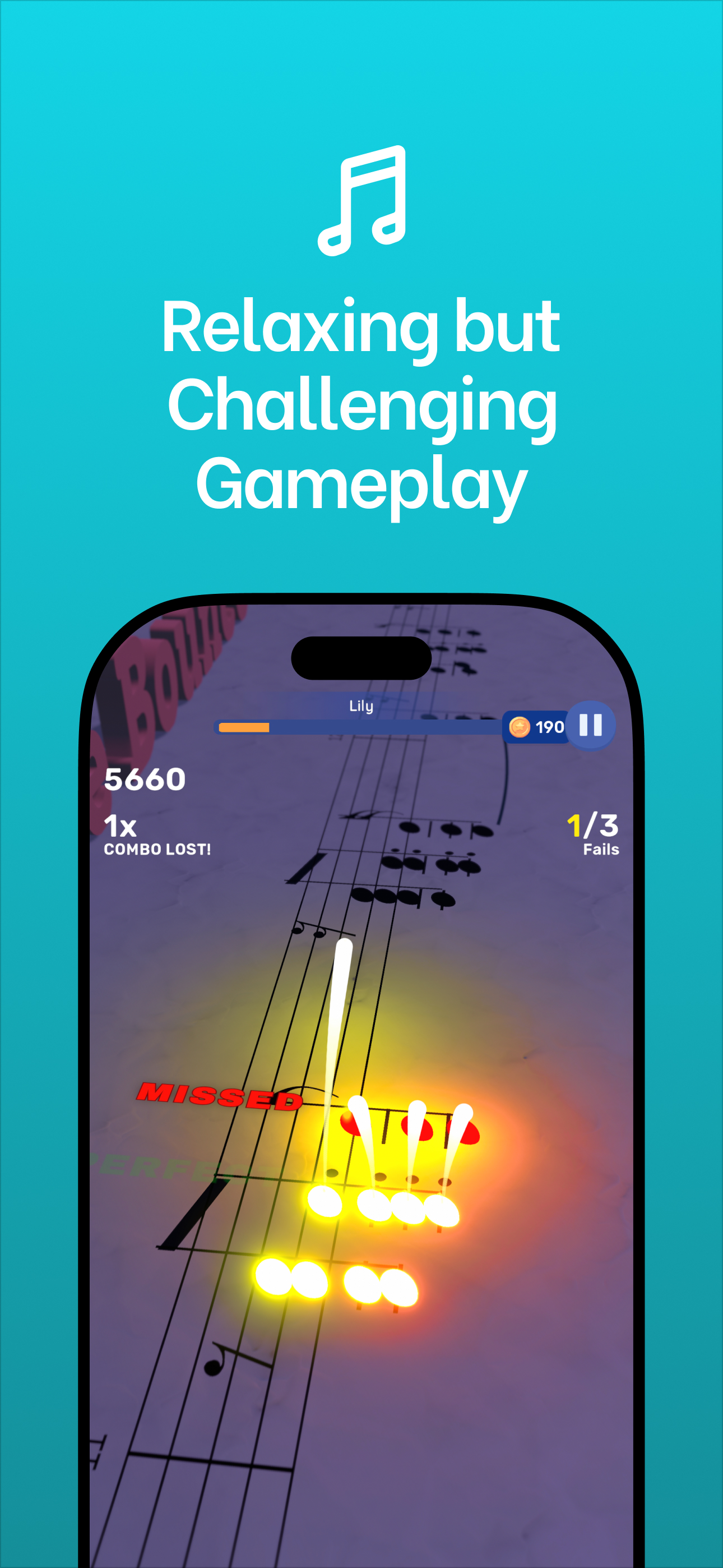
Then put it to work on real notation. In Note Bounce, the balls land on the notes in time, so you see each beat of the bar as it happens. Import a MIDI of a waltz or a jig to build your own level and watch where the bar lines fall while you count out loud.
Next step
Pick one tune for each meter from this page and count it out loud before you play or listen. Once 4/4, 3/4 and 6/8 feel different in your body, most new time signatures are variations on one of them; cut time and odd meters like 5/4 and 7/8 are good next reads.
Another way to sense meter is to hear a bar repeat. In RingLoop, every song is built from concentric rings, and clearing a ring in time adds its instrument to the mix, so you hear the same bar cycle round and round as the loop fills in. It's a quick way to feel where "one" lands.
Frequently asked questions
What is the most common time signature?
4/4 is so widely used that it is called common time and is often written as a C instead of numbers. Most pop songs, marches and beginner pieces use it.
What's the difference between 3/4 and 6/8?
Both bars hold six eighth notes, but they are grouped differently. 3/4 has three beats of two eighths each (ONE-and-TWO-and-THREE-and), while 6/8 has two beats of three eighths each (ONE-two-three-FOUR-five-six).

Get Note Bounce
Learn to read sheet music while you play. Free on iOS, Android and Steam.