Ode to Joy: The Best First Classical Piece to Read
Ode to Joy is the best first classical piece to read because almost every note moves by step to its neighbor, the whole melody fits in five notes, and it sits in steady 4/4 time. In the common C-major beginner version, the opening goes E E F G G F E D C C D E E D D, and once you can read that line you can read three of its four phrases.
That's a rare combination. Most famous melodies jump around or use rhythms that are hard to count. Ode to Joy lets you practice the core reading skill, following notes up and down the staff, without distractions. This guide walks through it phrase by phrase and points out the three places where beginners usually trip.
If you can't name the lines and spaces yet, start with the beginner's guide to reading sheet music. Everything below assumes the treble staff.
Where the melody comes from
The tune is the main theme of the last movement of Beethoven's Symphony No. 9 in D minor, first performed in Vienna in 1824. The words are from Friedrich Schiller's poem An die Freude ("To Joy"), according to Wikipedia's article on the symphony. Beethoven's orchestral version is in D major; beginner books almost always move it to C major so it uses only white keys. The letter names below use that C-major version.
Why it's an ideal first read
| Feature | Why it helps a reader |
|---|---|
| Stepwise motion | Each note is on the next line or space up or down, so your eye moves one position at a time |
| Five-note range | Only C, D, E, F and G, the notes from middle C up to the G on the second line |
| 4/4 time, mostly quarter notes | Easy to count: one note per beat |
| Repeated phrases | Phrases 1, 2 and 4 are nearly identical |
The five-note range is the big one. Middle C sits on a ledger line below the staff, D hangs just under the bottom line, E is on the bottom line, F in the first space, and G on the second line. Learn those five spots and you can read the whole tune.
Phrase by phrase
The melody has four phrases of four bars each. Read each one out loud before you play or listen.
Phrase 1: up and back down
E E F G | G F E D | C C D E | E. D D
Climb from E to G, walk back down to C, then climb again to E. The last bar has a dotted quarter E followed by an eighth-note D and a half-note D. It ends on D, which sounds unfinished, like a question.
Phrase 2: same start, different ending
E E F G | G F E D | C C D E | D. C C
Identical to phrase 1 until the final bar, which ends on C. This sounds finished, like an answer. Spotting this "question and answer" pattern is a reading skill in itself: you only need to read the last bar fresh.
Phrase 3: the middle section
D D E C | D E-F E C | D E-F E D | C D G
This is the only part with new shapes. Two things to watch:
- The eighth notes. "E-F" is two eighth notes sharing one beat. Count "and" between beats to fit them in.
- The drop to low G. The phrase ends by dropping from D down to the G below middle C, the one note outside the five-note range. It sits just below the second ledger line under the staff. Some easy books replace it with the G on the second line to stay in range. Check your edition.
Phrase 4: the famous early entrance
E E F G | G F E D | C C D E | D. C C
The notes match phrase 2. What makes this phrase famous is rhythm: in Beethoven's original, the melody comes back a beat early, starting on the last beat of the previous bar and tied across the bar line. That small syncopation is why the return sounds so lifted. Many beginner editions straighten it out so phrase 4 starts on beat one; if yours keeps the tie, count it carefully and hold the tied note through the bar line.
Where beginners trip
- The repeated notes. "E E" and "C C" are the same note twice. Beginners often move on the second one. If the notehead doesn't move on the staff, your note doesn't either.
- The dotted rhythm at the end of phrases 1 and 2. A dotted quarter is one and a half beats. Count "one-and-two" for the dotted note, then play the eighth note on the "and".
- The jump in phrase 3. Everything else is stepwise, so the leap down to low G catches readers off guard. Look ahead to it before you start the phrase.
Practice it as a game
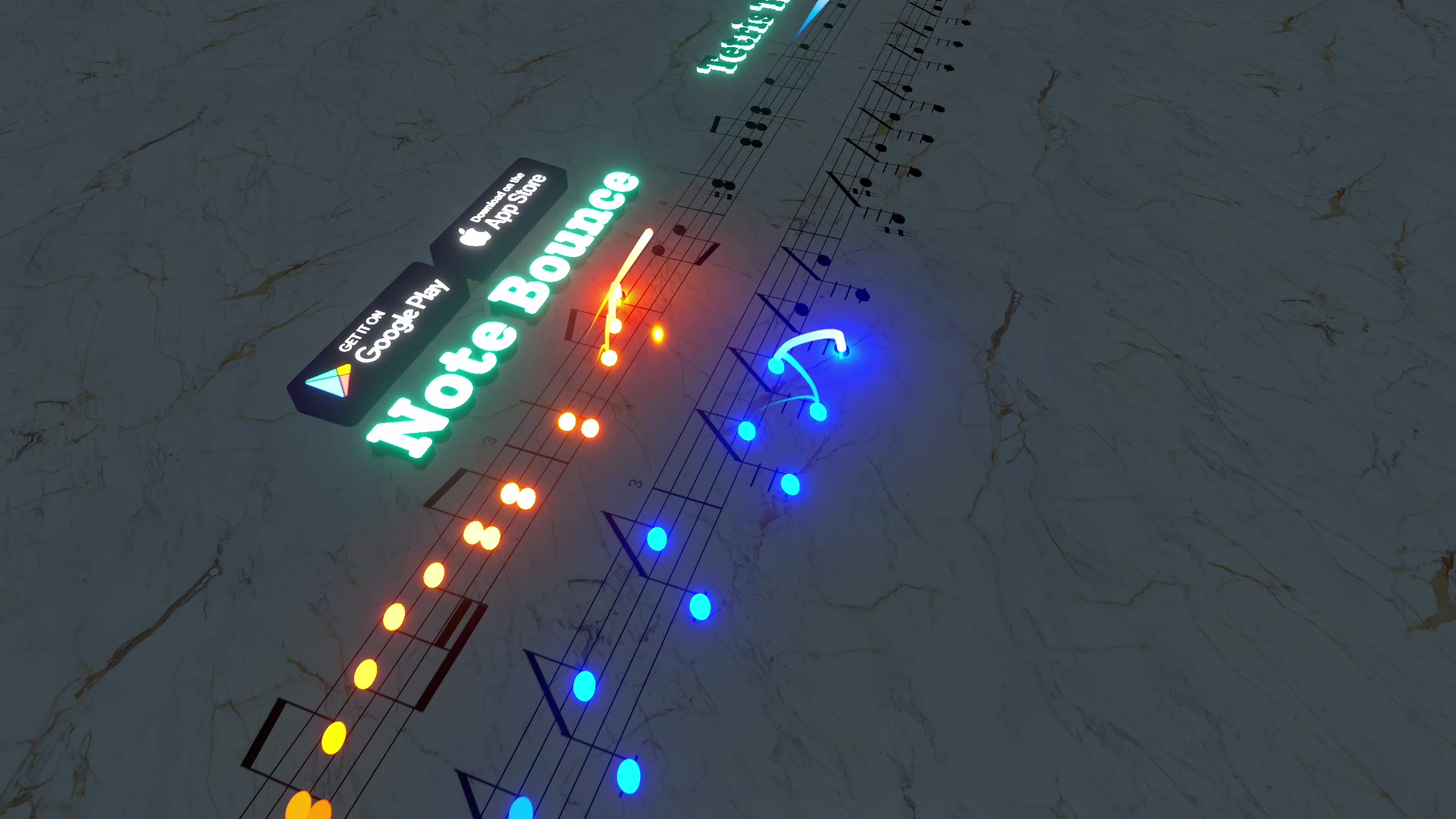
Import an Ode to Joy MIDI file into Note Bounce to build a custom level, then play it while naming each note out loud as the ball lands. The balls land on real sheet music, so you're reading the actual notation in time, not memorizing a pattern. Play phrases 1 and 2 until they feel automatic, then add phrase 3.
For a MIDI to start from, look for an easy arrangement, or export your own from a notation program such as MuseScore. If you want a free file to try, Marble Music (formerly Beat Bounce), the bouncing-marble music video app, hosts a library of more than 1,100 free MIDI files; search it for Ode to Joy and check which version suits your level. You can import the file into Note Bounce to read it, or into Marble Music to turn it into a satisfying marble video. Browse the Marble Music MIDI library.
Your next piece
Once Ode to Joy feels easy, choose a piece that adds exactly one new challenge: a wider range, a new time signature such as 3/4, or a sharp or flat in the key signature. Reading grows fastest when each new piece stretches one skill at a time.
Frequently asked questions
What are the notes for Ode to Joy?
In the common beginner version in C major, the first line is E E F G G F E D C C D E E D D. The second line is the same until the end, which finishes on C instead: E D C C.
Who wrote Ode to Joy?
The melody is from the final movement of Beethoven's Symphony No. 9, first performed in 1824. The words come from Friedrich Schiller's poem An die Freude.

Get Note Bounce
Learn to read sheet music while you play. Free on iOS, Android and Steam.