Minuet in G: How to Read the Famous Opening Bars
The Minuet in G opens with a quarter-note D, four eighth notes climbing G-A-B-C, then D, G and G, all in 3/4 time with one sharp (F♯) in the key signature. Once you can read those two bars, the next two follow the same shape one step higher, and the rest of the first page reads as short scale runs.
That pattern-based design is why it's one of the most common early pieces in piano books. This guide covers who actually wrote it, what the key and time signatures tell you before you play, and a bar-by-bar read of the opening. If you still need the basics of the staff, start with the beginner's guide to reading sheet music.
Who wrote it (probably not Bach)
The piece appears in the 1725 Notebook for Anna Magdalena Bach, a collection of keyboard pieces kept by J.S. Bach's second wife, so for a long time it was simply called "Bach's Minuet in G". According to Wikipedia's article on the Minuets in G major and G minor, it was later identified as part of a harpsichord suite by Christian Petzold, an organist in Dresden. Its catalogue number, BWV Anh. 114, reflects that: "Anh." means Anhang, the appendix of the Bach catalogue for doubtful or misattributed works. It's usually paired with the Minuet in G minor, Anh. 115.
Either way, it's a public-domain Baroque dance, and you can find free scores of it on IMSLP and the Mutopia Project.
Read the signs before the notes
Look at the start of the first line before you read a single note. Three things are set there:
| Sign | What you see | What it means for you |
|---|---|---|
| Clefs | Treble on top, bass below | Right hand plays the melody, left hand a simple bass line |
| Key signature | One sharp, on the top F line | Every F is F♯ unless marked otherwise |
| Time signature | 3/4 | Three quarter-note beats per bar, strong on beat one |
The key signature is the one most beginners forget. In this piece the F♯ shows up as soon as bar 3, right at the top of a climbing run. If you play F natural there, it sounds wrong at once, so circle the first F in pencil as a reminder.
A minuet is a dance in three, so count "ONE two three" and give beat one a little more weight.
Bar by bar: the first four bars
Here's the right-hand melody, with the count under each bar. Eighth notes take half a beat each, so count them "and".
Bar 1: D, then a run up from G
- Beat 1: D (quarter note), the fourth line of the treble staff.
- Beats 2 and 3: G A B C (four eighth notes), starting on the second line and stepping up line, space, line, space.
Count: "ONE, two-and, three-and". The run is a scale, so once you find the G you don't need to read each note separately; just step up.
Bar 2: D, G, G
- Three quarter notes: D, then G, then G.
- The jump from D down to G is a fifth, the first real leap in the piece. Look for the G on the second line rather than counting down.
Bar 3: the same shape, one step higher
- Beat 1: E (quarter note), the top space.
- Beats 2 and 3: C D E F♯ (eighth notes), stepping up from the third space. That last note is the F♯ from the key signature.
Bar 4: G, G, G
- Three quarter notes on G. The first is the high G just above the staff; the second and third drop back to the G on the second line.
Notice what you just did: bars 3 and 4 are a copy of bars 1 and 2 moved up one step. Spotting repeats and shifts like this is what makes the rest of the piece read fast.
Where beginners slip
- Rushing the eighth notes. The run in bar 1 is exciting to play, and it's easy to speed up. Keep counting "two-and, three-and" so the run fills exactly two beats.
- Forgetting the F♯. It returns in later bars too. Check the key signature again whenever you see an F.
- Losing beat one. In 3/4 it's tempting to drift into a steady four. Tap your foot only on ONE for a few passes.
Practice it as a game
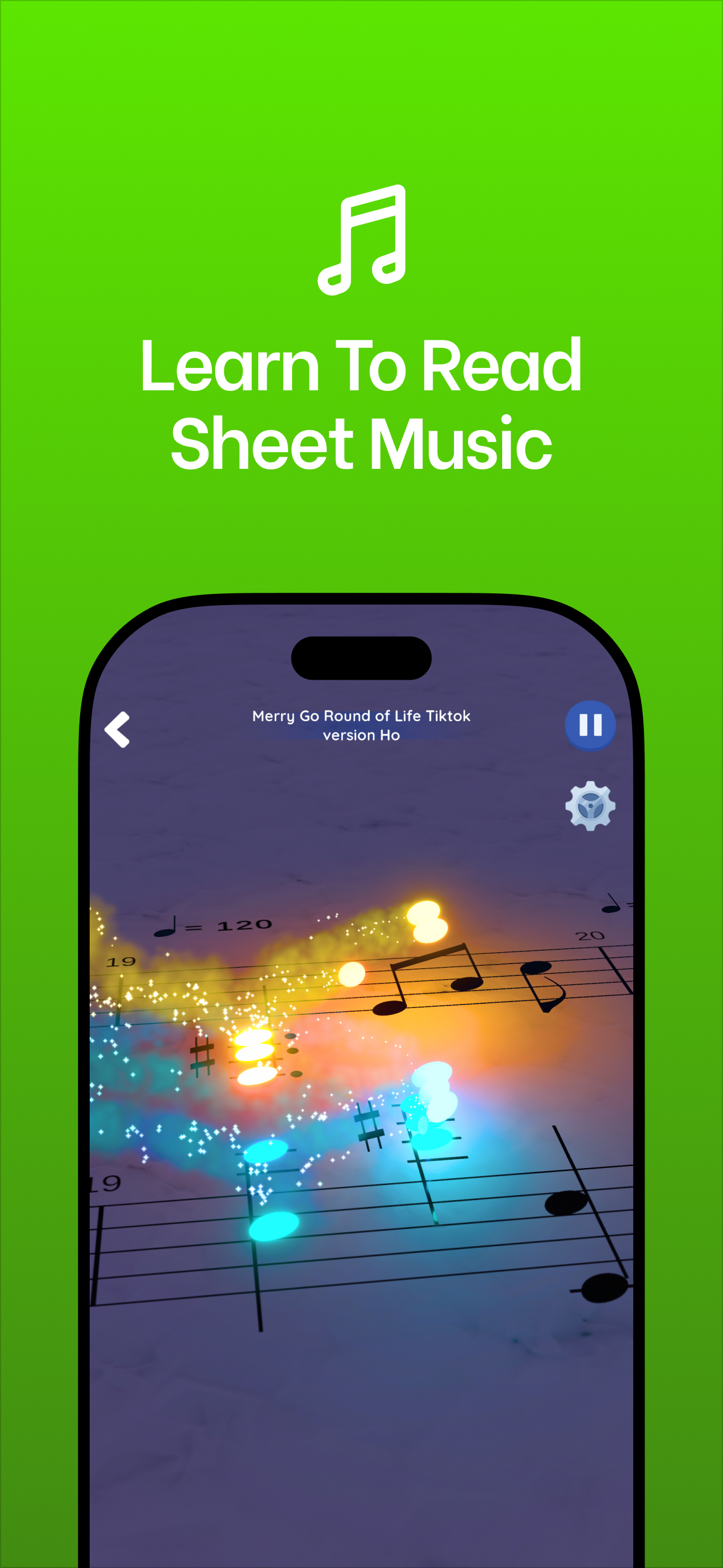
Import a MIDI of the Minuet in G into Note Bounce to build your own level. The balls land on real sheet music in time, so you see each run and each leap as it's played. Name the notes of bars 1 to 4 out loud as the balls land, then add the next phrase once those feel automatic. If you use someone else's MIDI arrangement, check its license; the composition is public domain, but a particular file may not be.
To feel the dance from a different angle, try RingLoop, where every song is built from concentric rings and each ring you clear in time adds its instrument to the mix. As the parts stack up, the strong ONE of a three-beat loop becomes easy to hear. Try it at RingLoop.
Your next eight bars
Read bars 1 to 4 until you can say the note names without stopping, then open a free score and look at bars 5 to 8 before you play them. Find the first note of each bar, decide whether the notes after it step up or down, and count "ONE two three". Most bars on the first page follow that same pattern.
Frequently asked questions
Did Bach write the Minuet in G?
It appears in the 1725 Notebook for Anna Magdalena Bach and was long credited to J.S. Bach, but researchers now attribute it to the Dresden organist Christian Petzold. It is catalogued as BWV Anh. 114.
What are the first notes of the Minuet in G?
The right hand opens D, G-A-B-C, D, G, G: a quarter-note D, four quick eighth notes climbing from G, then D and two repeated Gs. The next two bars repeat the shape a step higher, starting on E.
Is the Minuet in G good for beginners?
Yes. It uses one sharp, stays in 3/4, and its melody is built from short scale runs, so you can read it by steps once you find the first note of each bar.

Get Note Bounce
Learn to read sheet music while you play. Free on iOS, Android and Steam.