Korobeiniki: The Folk Song Behind the Tetris Melody
Korobeiniki is a 19th-century Russian folk song, and it is the melody most people know as the Tetris theme. It started as a poem by Nikolay Nekrasov, printed in 1861, and its tune became so popular as a folk song that a video game later carried it around the world.
This post covers where the song came from and how it reached a game console, then walks you through reading its first phrase note by note. It is a good piece to practice with: short, stepwise, and instantly recognizable, so you know right away when you have read it correctly.
From a Nekrasov poem to a folk song
"Korobeiniki" means "the peddlers." Nikolay Nekrasov's poem of that name first appeared in the Russian literary magazine Sovremennik in 1861. It tells of a traveling peddler who meets a young woman, and their haggling over his wares works as a playful metaphor for courtship.
The poem was set to music and spread the way folk songs do: people sang it, changed it, and passed it on, until it became a well-known Russian folk song. You will also see it under the shorter title "Korobushka."
How it became the melody known as the Tetris theme
The version most people remember came in 1989, when composer Hirokazu Tanaka arranged it as the "Type A" music for the Game Boy release of Tetris, according to the same article. Its short, driving phrases loop easily, which suits a game you can play for a long time.
Two plain points worth knowing if you play or share it:
- The folk melody is in the public domain.
- "Tetris" is a trademark, and specific game arrangements and recordings can still be protected. Play the melody itself, or an arrangement whose license you have checked, and don't present your video as connected to the game.
Read the first phrase, note by note
The first phrase is four bars in 4/4, written here in the treble clef. Note names use octave numbers, where C4 is middle C. (If the treble clef is new to you, the beginner's guide to reading sheet music covers the lines, spaces and note values used below.)
| Bar | Notes | Rhythm |
|---|---|---|
| 1 | E5, B4, C5, D5, C5, B4 | quarter, eighth, eighth, quarter, eighth, eighth |
| 2 | A4, A4, C5, E5, D5, C5 | quarter, eighth, eighth, quarter, eighth, eighth |
| 3 | B4, C5, D5, E5 | dotted quarter, eighth, quarter, quarter |
| 4 | C5, A4, A4 | quarter, quarter, quarter (then a quarter rest) |
Where each note sits on the treble staff:
- E5: the top space (the last letter of FACE).
- D5: the fourth line.
- C5: the third space.
- B4: the middle line.
- A4: the second space.
So the whole phrase lives in the upper half of the staff, between the second space and the top space. Your eyes barely need to move.
Three patterns that make it easy to read
Instead of reading every note from scratch, look for the patterns that repeat.
1. Stepwise motion
Most of the phrase moves by step: line to the next space, or space to the next line. Bar 1 goes E, then down to B, then climbs C, D and comes back down C, B. Once you notice that the notes sit next to each other, you only need to find the first one and read the rest as "up one, down one."
2. The A-minor feel
The phrase starts on E, leans on A again and again, and comes to rest on A at the end of bar 4. Every note in it belongs to the A minor scale (A, B, C, D, E). That is why it sounds a little wistful even at a fast tempo. Reading tip: when you see the line of notes settle on the second space, expect the phrase to land there.
3. The repeated rhythm
Bars 1 and 2 share the same rhythm: long, short-short, long, short-short. Count it as "1, 2-and, 3, 4-and." Once you have clapped bar 1, you already know the rhythm of bar 2, so you can put all your attention on the pitches. Bar 3 changes the pattern with a dotted quarter, which gives the line its little push forward before the final A.
Hear it built one layer at a time
Once you know the melody, it is fun to hear how its parts fit together. RingLoop is a rhythm game where every song is a set of rings, and each ring you clear adds its instrument to the mix, like a loop station. Its catalogue includes classical melodies remixed into neon alongside chiptune originals, and its level editor imports MIDI files with one ring per track, so a Korobeiniki MIDI lets you hear melody, bass and harmony join one by one.
Play it in Note Bounce
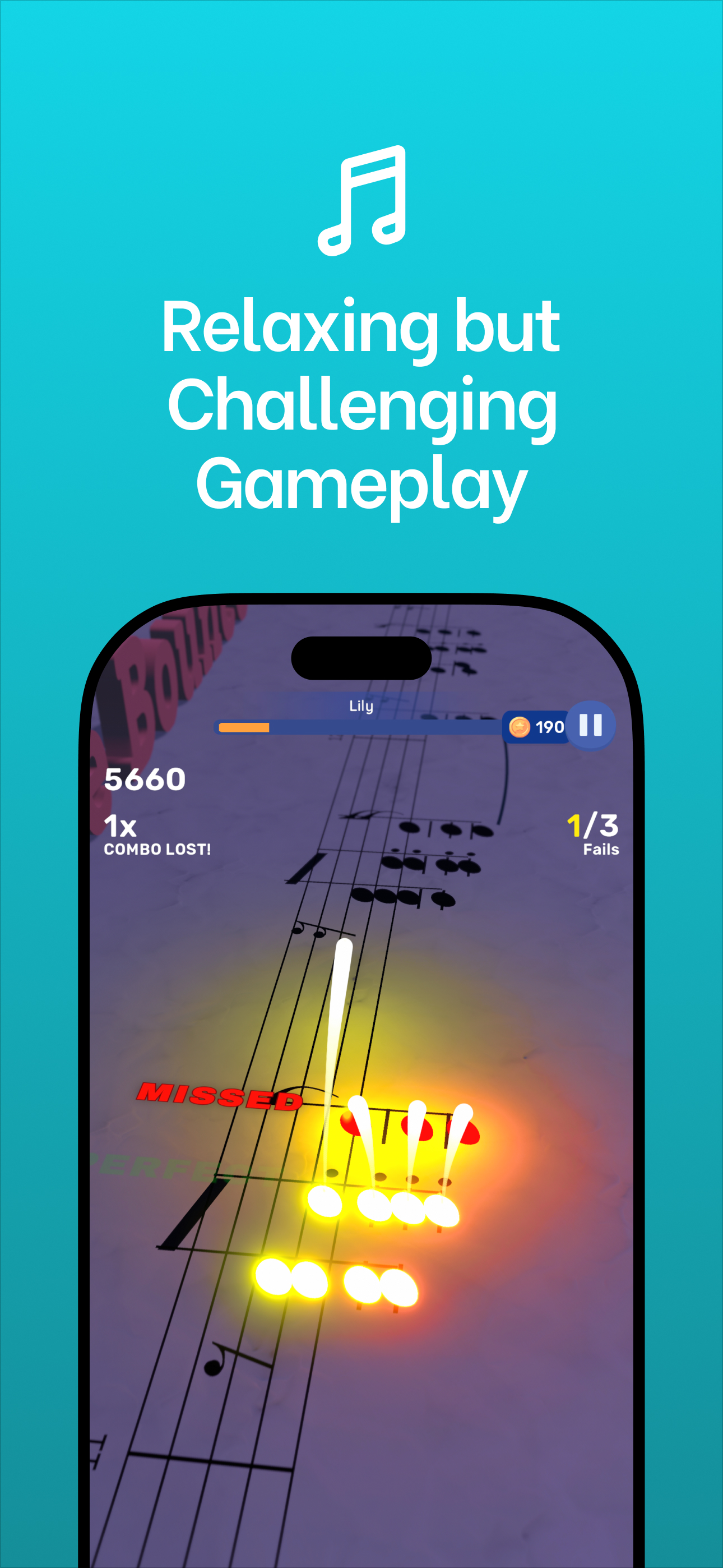
The Korobeiniki gameplay shown on the Note Bounce site is a good way to try this reading walkthrough at speed. Bouncing balls land on real notes on the staff, so you can check each pitch and rhythm from the table above as it goes by.
A simple practice plan:
- Say the notes. Read bars 1 to 4 out loud from the table above, without any rhythm.
- Clap the rhythm. Count "1, 2-and, 3, 4-and" for bars 1 and 2, then clap bars 3 and 4.
- Play it. Watch for the patterns as the balls land: the steps in bar 1, the leap up to E in bar 2, and the settle onto A at the end.
If you want to build your own level, Note Bounce's MIDI import turns a MIDI file into a playable level. For a public-domain score or MIDI, the Mutopia Project is a good place to look, and check the license of any arrangement you use.
Frequently asked questions
Is the Tetris theme a real Russian song?
Yes. The melody known as the Tetris theme is "Korobeiniki", a 19th-century Russian folk song based on Nikolay Nekrasov's poem of the same name, first printed in 1861.
Is Korobeiniki public domain?
The folk melody is in the public domain. "Tetris" is a trademark, and specific game arrangements and recordings can still be protected by copyright, so use the melody itself or an arrangement whose license allows it.

Get Note Bounce
Learn to read sheet music while you play. Free on iOS, Android and Steam.