Key Signatures Explained: Find the Key in 5 Seconds
A key signature is the group of sharps or flats at the start of each line of music, and it tells you which notes are raised or lowered for the whole piece. To find the major key fast: with sharps, go one half step up from the last sharp; with flats, the second-to-last flat is the key (and one flat on its own means F major).
That's the five-second method. The rest of this guide explains why it works, how to remember the order of sharps and flats, how to tell a major key from its relative minor, and how to stop forgetting the key signature halfway down the page. If sharps and flats themselves are new to you, start with how sharps, flats and naturals work.
What a key signature does
A key signature saves writing. Instead of putting a sharp sign in front of every F in a piece, the composer puts one sharp on the F line at the start of each staff. From then on:
- Every F is F♯, in every octave, for the whole piece.
- It stays that way until the key signature changes or an accidental overrides one note for a bar.
That's the difference from an accidental, which lasts only to the end of a bar. The key signature is the default; accidentals are exceptions.
The order of sharps and flats
Sharps and flats always appear in the same order, so you only have to remember two sequences.
| Order | Memory phrase | |
|---|---|---|
| Sharps | F C G D A E B | Father Charles Goes Down And Ends Battle |
| Flats | B E A D G C F | Battle Ends And Down Goes Charles' Father |
The flat order is the sharp order backwards, so one phrase gives you both. A key signature with three sharps always has F♯, C♯ and G♯; it never skips one.
Finding the major key
With sharps: last sharp, up a half step
Look at the sharp furthest to the right. Go up one half step (the very next key on a piano). That's the major key.
- One sharp (F♯) → up a half step → G major
- Two sharps (F♯, C♯) → D major
- Three sharps (F♯, C♯, G♯) → A major
- Four sharps (last is D♯) → E major
With flats: the second-to-last flat
Look at the second flat from the right. That's the major key, flat included.
- Two flats (B♭, E♭) → second-to-last is B♭ → B♭ major
- Three flats (B♭, E♭, A♭) → E♭ major
- Four flats (B♭, E♭, A♭, D♭) → A♭ major
One flat has no "second-to-last", so memorize it: one flat is F major.
No sharps or flats
An empty key signature means C major (or A minor, as below).
Major or relative minor?
Every key signature fits two keys: a major key and its relative minor. The relative minor's home note is three half steps (a minor third) below the major key's name.
| Key signature | Major key | Relative minor |
|---|---|---|
| None | C major | A minor |
| 1 sharp | G major | E minor |
| 2 sharps | D major | B minor |
| 1 flat | F major | D minor |
| 2 flats | B♭ major | G minor |
To decide which one a piece is in:
- Check the ending. Pieces usually end on their home note or chord. A piece with no key signature that ends on A is probably in A minor.
- Look for a raised seventh. Minor-key pieces often add an accidental sharp on the note just below the home note. In A minor that's G♯, which shows up throughout Für Elise.
- Listen. If the piece sounds darker, minor is the likely answer, but use the first two clues to confirm.
How not to forget the key signature
The most common reading mistake isn't misnaming a note; it's forgetting that the key signature changes it. A few habits help:
- Say it before you start. "Two sharps, D major, F and C are sharp."
- Circle the first affected note. In practice copies, mark the first F♯ or B♭ so your eye is primed.
- Recheck every line. The key signature is reprinted on each line for a reason. Glance at it when your eyes jump down.
- Watch for changes. A double bar line followed by a new key signature means the rules have changed from there on.
A 60-second self-test
Cover the answers and name the major key.
- Three sharps. (A major)
- One flat. (F major)
- Three flats. (E♭ major)
- One sharp. (G major)
- No sharps or flats, and the piece ends on A. (A minor)
- Two sharps, and the piece ends on B. (B minor)
If you got five or six, you can name the key of most beginner pieces at a glance.
Practice keys in real music
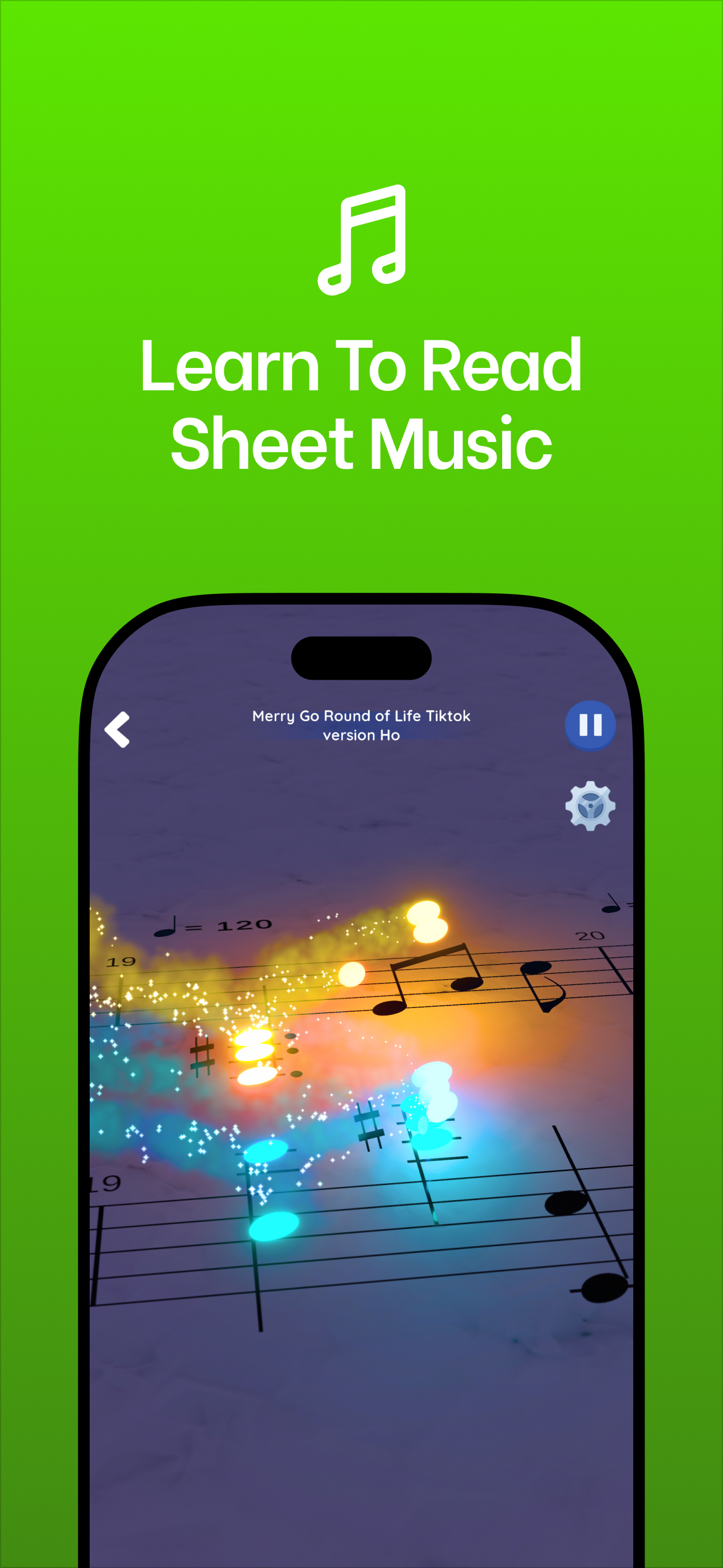
Theory sticks best when you see it in real notation. In Note Bounce, balls bounce onto real sheet music in time, so you're reading the actual notes, sharps and flats included. Import MIDIs of pieces in different keys to build custom levels, and before each one, say the key signature out loud. If the staff itself is still new, the beginner's guide to reading sheet music covers the lines and spaces first.
Need pieces in several keys? Marble Music (formerly Beat Bounce), the bouncing-marble music video app, hosts more than 1,100 free MIDI files on its site. Pick a few in different keys, import them into Note Bounce to read, or into Marble Music to watch the marble bounce on every note. Browse the Marble Music MIDI library.
Frequently asked questions
How do you tell if a song is in a major or minor key?
Each key signature fits one major key and one minor key. Look at the last note of the melody or the last chord: pieces usually end on their home note. If the ending points to the note a minor third below the major key's name, it's probably the relative minor.
What key has no sharps or flats?
C major and its relative minor, A minor. Both use only the white keys of a piano.
Get Note Bounce
Learn to read sheet music while you play. Free on iOS, Android and Steam.