Dotted Notes and Ties: How to Count Them Without Guessing
A dot after a note adds half of that note's value, so a dotted half note lasts three beats and a dotted quarter lasts one and a half. A tie is a curved line joining two notes of the same pitch: you play the first note and hold it for the combined length of both, without striking the second.
Both signs make a note longer than a single note shape allows. The rules are short; the real skill is counting them in time. If the note shapes themselves are still new, start with the beginner's guide to reading sheet music and come back.
The dot rule in one table
Take the note's normal value, halve it, and add the half back on. The table assumes a time signature with a 4 on the bottom (4/4, 3/4, 2/4), where a quarter note gets one beat.
| Note | Plain value | Dotted value | Count it as |
|---|---|---|---|
| Half note | 2 beats | 2 + 1 = 3 beats | 1-2-3 |
| Quarter note | 1 beat | 1 + 1/2 = 1 1/2 beats | 1-and-2 |
| Eighth note | 1/2 beat | 1/2 + 1/4 = 3/4 beat | 1-e-and |
| Whole note | 4 beats | 4 + 2 = 6 beats | crosses a 4/4 bar, so it's rare there |
Two details catch beginners:
- The dot sits to the right of the notehead, not above or below it. A dot above or below the head is a staccato mark, which means "short and detached", the opposite idea.
- Dots work on rests too. A dotted quarter rest is one and a half beats of silence.
A rarer double dot adds half of what the first dot added, so a double-dotted half note is 3 1/2 beats.
Counting a dotted quarter, step by step
The dotted quarter followed by an eighth note is the most common dotted rhythm you'll read. Together they fill exactly two beats: 1 1/2 + 1/2 = 2.
Here's how to count it without guessing:
- Subdivide first. Count steady eighths out loud: "1-and-2-and-3-and-4-and".
- Start the dotted quarter on its beat and hold it through three syllables: "1-and-2".
- Play the eighth note on the "and" of 2. It lands between beats, which is why it feels slightly early if you weren't counting.
- Keep the count going into the next note on beat 3.
Worked example: Ode to Joy. In the common C-major beginner version of Beethoven's melody, the first phrase ends with a dotted quarter E, an eighth-note D and a half-note D. Count the bar as "1-and-2-and-3-and-4-and": E sounds on 1 and holds through "2", D sounds on the "and" of 2, and the final D sounds on 3 and holds to the end of the bar. The most common mistake is making the E only one beat long, which turns the long-short rhythm into two even notes.
The same logic scales down. A dotted eighth followed by a sixteenth fills one beat. Count "1-e-and-a", hold the dotted eighth through "1-e-and" and put the sixteenth on "a". That snappy long-short pattern is what gives many marches their bounce.
Ties: one sound across two notes
A tie looks like a small curve from one notehead to the next, and the two notes are always the same pitch. You play the first note and keep holding it; the second note is never struck again. Add the values together to get the total length.
For example, in 4/4 a quarter tied to a quarter sounds like a half note (2 beats), and a whole note tied to a quarter in the next bar lasts 5 beats.
So why write a tie when a single note would do? There are two good reasons:
- Crossing a bar line. Every bar must add up to the time signature. A note that starts on beat 4 and lasts two beats can't fit in one bar, so it is split into a quarter at the end of the bar, tied to a quarter at the start of the next.
- Showing the beat. Inside a bar, composers often tie notes rather than use one long value, so the middle of the bar stays visible. A note starting on the "and" of 1 and lasting a full beat is easier to read as an eighth tied to an eighth than as a quarter sitting off the beat.
When counting a tie, keep saying every beat out loud even while you hold the note. Your voice keeps the time, and your hand keeps the sound.
Tie or slur? A four-point check
Ties and slurs both look like curved lines, and mixing them up is one of the most common reading errors. Run this check whenever you see a curve:
- Same pitch on both ends? If the two notes sit on the same line or space, it's a tie. Different pitches mean it's a slur.
- How many notes does it cover? A tie joins two neighboring notes; a curve over three or more is a slur.
- Where does it attach? A tie runs closely from notehead to notehead. A slur usually arches more widely over or under a whole group.
- Does an accidental carry? If a sharpened note is tied across a bar line, the sharp still applies to the tied note in the next bar, because it's the same sound.
If all four point to a tie, hold one sound. If not, play every note, smoothly connected.
Practice the long-short feel
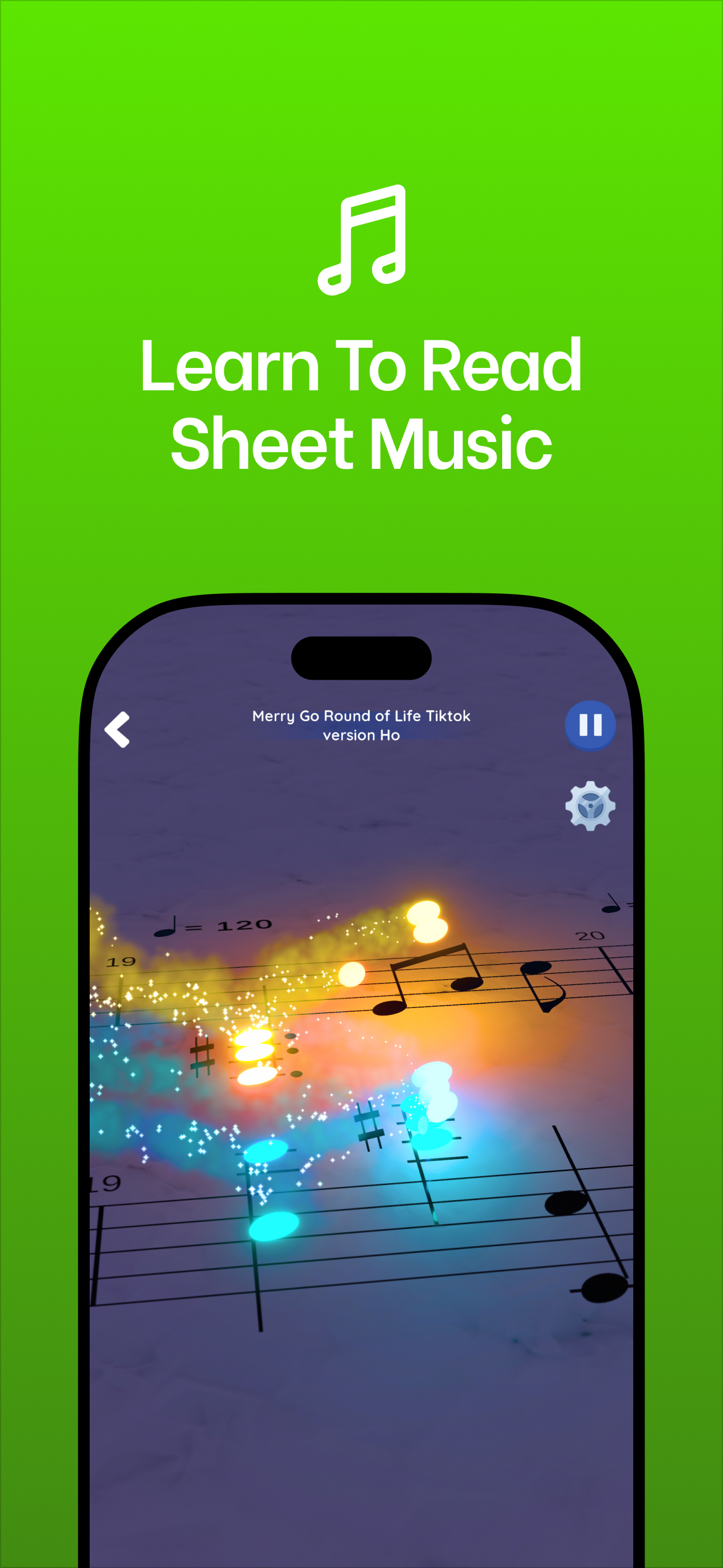
Dotted rhythms and ties are easier to read once you can see the timing, not just count it. In Note Bounce, balls land on the notes of real sheet music in time, so a dotted quarter shows up as a longer gap before the next landing and the short note after it arrives quickly. Import a MIDI of a public-domain melody with dotted rhythms to build your own level.
To hear the same rhythms from a different angle, Marble Music (formerly Beat Bounce) turns MIDI files into bouncing-marble music videos where the marble bounces on every note. Watching the marble hang in the air during a dotted note and hop quickly on the short note after it makes the long-short pattern easy to spot. It also hosts a free Ode to Joy MIDI you can try in either app; check the arrangement suits your level first.
Try it today
Pick a simple melody and find its first dotted note or tie. Write the count under it, clap the bar three times while saying the count, then play or sing it. Repeat with one new bar a day until long-short rhythms read by sight.
Frequently asked questions
How many beats is a dotted quarter note?
In 4/4, 3/4 or 2/4, a dotted quarter note lasts one and a half beats: one beat for the quarter note plus half a beat for the dot. It is usually followed by an eighth note that finishes the second beat.
What is the difference between a tie and a slur?
A tie connects two notes of the same pitch, and you play only the first one and hold it through the second. A slur arches over notes of different pitches and tells you to play them smoothly connected, each one sounded.
Can a dot go on a rest?
Yes. A dot after a rest works the same way as after a note: it adds half of the rest's value, so a dotted quarter rest is one and a half beats of silence.

Get Note Bounce
Learn to read sheet music while you play. Free on iOS, Android and Steam.