Für Elise Sheet Music: How to Read the Famous A Section
To read the famous part of Für Elise, count it in 3/8 (three eighth-note beats per bar), follow the melody as it passes from the right hand to the left hand and back, and watch for the sharps that aren't in the key signature, mainly D♯ and G♯. The A section repeats almost note for note several times, so once you can read its first eight bars, you can read most of what people recognize as Für Elise.
This spotlight goes beyond the opening wiggle. It maps the whole piece, explains how the A section is put together bar by bar, and shows where readers usually get lost.
A short history
Für Elise is Beethoven's Bagatelle No. 25 in A minor, WoO 59. According to Wikipedia, it was composed in 1810 but not published until 1867, after the scholar Ludwig Nohl found it, about 40 years after Beethoven's death. Who "Elise" was is still debated. Suggested candidates include Therese Malfatti, a friend and student of Beethoven's, and the soprano Elisabeth Röckel.
The composition is in the public domain. Modern editions and arrangements can have their own rights, so check the license of any score or MIDI you use.
Map of the whole piece
Für Elise is a rondo: the main theme keeps coming back, with contrasting sections in between.
| Section | Character | Reading difficulty |
|---|---|---|
| A | The famous theme, gentle and flowing | Moderate |
| B | Brighter, with faster right-hand runs | Harder |
| A | The theme again | You already know it |
| C | Dark, with repeated low notes in the left hand | Harder |
| A | The theme a final time | You already know it |
That's why learning to read the A section pays off: it makes up a large part of the piece.
Reading the 3/8 time signature
The time signature is 3/8: three eighth notes per bar. Most of the A section moves in sixteenth notes, two per eighth-note beat, so each bar holds six sixteenths.
Count it like this:
ONE-and-two-and-three-and | ONE-and-two-and-three-and
The piece starts with a pickup: the first two notes (E and D♯) come before the first full bar, on the "three-and" of an imaginary bar. Count "three-and" before you start so the first full bar lands on ONE.
The A section, bar by bar
Bars 1–2: the wiggle and the drop
The right hand alternates E and D♯, then steps down: E, B, D, C, and lands on A. The D♯ is a half step below E, and the D natural later in the bar is marked with a natural sign. Read the sign; don't play D♯ by habit.
Bars 2–3: the left hand takes over
When the right hand lands on A, the left hand plays a rising broken chord: A, E, A. Then the right hand answers with C, E, A, and lands on B, while the left hand plays a broken E-major chord with a G♯.
This handoff is the core of the A section. The melody seems to be one flowing line, but it's shared between the hands. On the page, that means reading the bass staff and the treble staff in turn, not at the same time.
Bars 4–8: the same idea again
The wiggle returns and the pattern repeats with a different ending. Where the first phrase climbed E, G♯, B and up to C, the second goes E, C, B and settles on A, which sounds finished. As with many classical themes, the first phrase asks a question and the second answers it.
Accidentals to watch
| Note | Where | Why it's there |
|---|---|---|
| D♯ | The wiggle in the right hand | Half step below E |
| G♯ | Left-hand E-major chord, and the right hand on the way to B | Gives the music its pull back to A minor |
A minor has no sharps in its key signature, so every sharp in Für Elise is written in as an accidental, and each lasts only until the bar line.
Where readers get lost
- The handoff. Readers who only watch the treble staff lose the melody when it moves to the left hand. Follow both staves, alternating your eyes.
- The natural sign. After two D♯s, the D natural catches people out.
- The pedal. Many editions mark the sustain pedal down on each new chord and up before the next. Read the pedal marks as part of the rhythm, not as an afterthought.
- Rushing the rests. The short pauses at the ends of phrases are written as rests. Count them, or the piece loses its breathing.
The E–D♯ opening is also satisfying to watch. Marble Music (formerly Beat Bounce) turns MIDI files into bouncing-marble music videos where the marble lands on every note, and its free MIDI library includes Für Elise files you can use there or import into Note Bounce. Browse the Marble Music MIDI library and check each file's license.
Read the A section, then move on
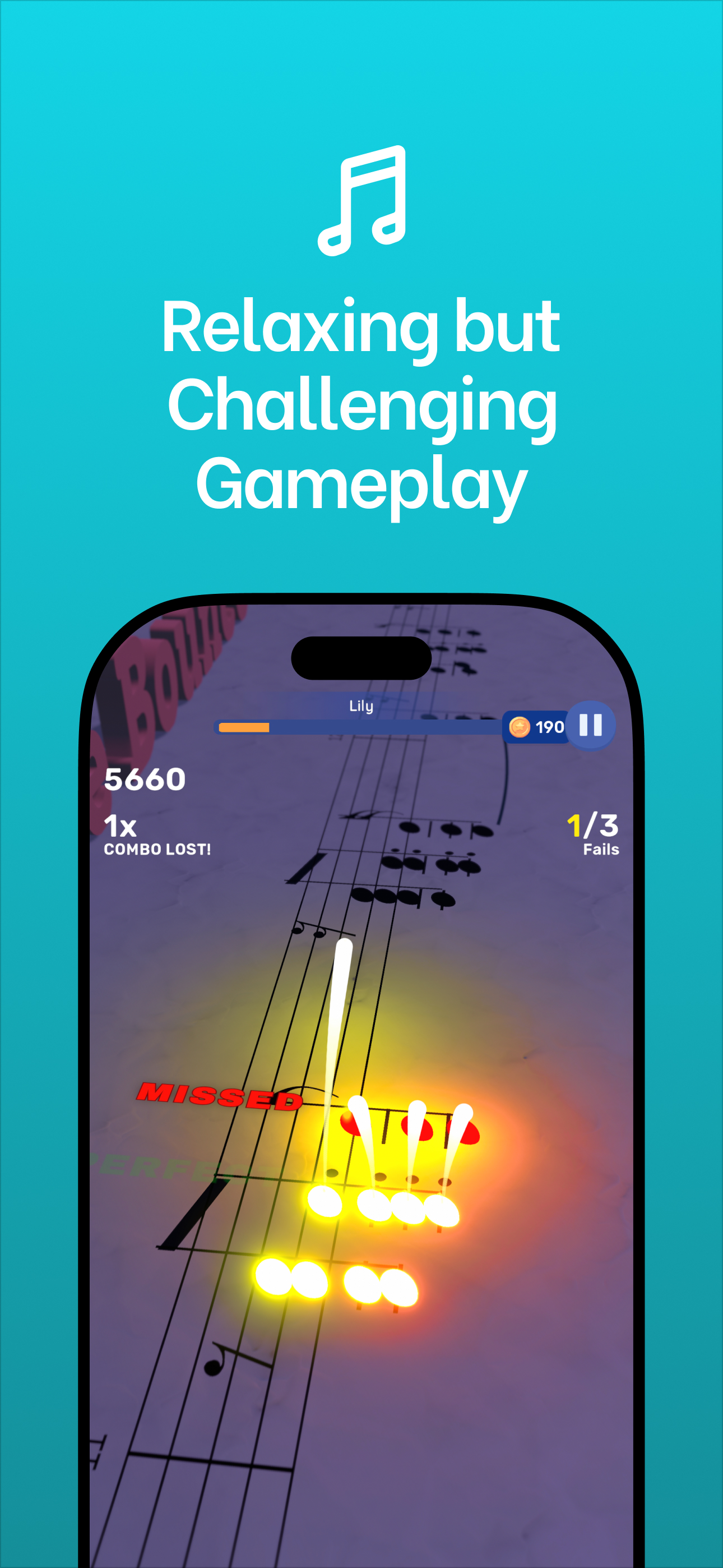
Import a Für Elise MIDI into Note Bounce to build a custom level. The balls land on the real notes in time, so you can practice following the melody across the hand-to-hand handoff at a steady pace. Start with the A section only, and say the sharp notes out loud ("D sharp", "G sharp") as the balls land on them. If accidentals still trip you up, the guide to sharps, flats and naturals covers how long each one lasts.
Once the A section reads smoothly, move on to section B. It uses the same 3/8 count, so the main new work is the faster right-hand notes.
Frequently asked questions
Is Für Elise easy to read?
The famous A section is one of the more approachable classical passages: it repeats a lot and sits in a small range. The middle sections are noticeably harder, with faster runs and wider leaps, so many learners start with the A section alone.
Who was Elise?
Nobody knows for sure. The piece was published in 1867, decades after Beethoven's death, and historians have suggested several candidates, including Therese Malfatti and the singer Elisabeth Röckel.

Get Note Bounce
Learn to read sheet music while you play. Free on iOS, Android and Steam.