Easy Christmas Songs to Learn to Read: Jingle Bells and More
The easiest Christmas songs to learn to read are Jingle Bells, Silent Night, Deck the Halls and We Wish You a Merry Christmas, roughly in that order, with Tchaikovsky's Dance of the Sugar Plum Fairy as a stretch goal. All five are public domain, and each one teaches a different reading skill, from repeated notes to a new time signature.
Below, each song gets a difficulty rating, a short note on where it comes from, and one reading tip. At the end you'll find how to get a clean MIDI file for each one and practice it as a game.
The list at a glance
| Song | Difficulty | What it teaches |
|---|---|---|
| Jingle Bells | 1 of 5 | Repeated notes and steady quarter notes |
| Silent Night | 2 of 5 | A gentle triple meter and dotted rhythms |
| Deck the Halls | 2 of 5 | Stepwise runs down the scale |
| We Wish You a Merry Christmas | 3 of 5 | 3/4 time and leaps of a fourth |
| Dance of the Sugar Plum Fairy | 5 of 5 | Staccato, accidentals and a wider range |
Difficulty here means reading difficulty in the simple versions found in most beginner books, not the difficulty of a full arrangement.
Five carols, easiest first
1. Jingle Bells
Why it's first: the chorus is mostly one note. In the common C-major version, it starts:
E E E | E E E | E G C D | E
That's seven Es before the melody moves at all. Every E is on the bottom line of the treble staff, so your job is to keep counting beats, not to find new notes. The song was written by James Lord Pierpont and published in 1857, according to Wikipedia.
Reading tip: the third bar is where the melody finally moves: E up to G, then a leap down to C, then a step up to D. Look ahead to that bar before you start. Then check yourself by singing the words: "Jingle bells, jingle bells, jingle all the way" has one syllable per note.
2. Silent Night
Why it's next: it's slow and moves mostly by step, but it introduces a lilting triple meter. Franz Xaver Gruber composed the melody in 1818 to words by Joseph Mohr, per Wikipedia. Editions write it in either 6/8 or 3/4, and both give it the same gentle, rocking feel.
Reading tip: the opening has a dotted rhythm, a long note followed by a short one, then a longer note. Count it slowly with the subdivisions out loud before you play. If your edition is in 6/8, feel two big beats per bar, each split into three.
3. Deck the Halls
Why it's here: the melody, from a Welsh tune, walks straight down the scale, so it's great practice at reading stepwise motion in a downward direction. Many beginners only practice reading upward; this one flips that.
Reading tip: when you see a run of notes stepping down, don't name each one from scratch. Find the first note, then just go "next line, next space" down the staff. The "fa la la la la" sections repeat the same shapes, so once you've read the first one, scan ahead for the copies.
4. We Wish You a Merry Christmas
Why it's harder: it's in 3/4, and it opens with a leap of a fourth (in many C-major versions, from G up to C) followed by quick notes. You have to read an interval and a faster rhythm at once.
Reading tip: practice recognizing the leap as a shape. A fourth goes from a line to a space or a space to a line, skipping two positions in between. Once you can spot that shape, you'll see it all over the song. Count "ONE two three" with the strong beat on one.
5. Dance of the Sugar Plum Fairy (stretch goal)
Why it's last: this is from Tchaikovsky's ballet The Nutcracker, which premiered in 1892, per Wikipedia. The melody uses short, detached notes, accidentals (sharps and flats written next to notes), and a wider range than the carols above. Even simplified versions take more reading work. The Sugar Plum Fairy reading guide walks through the opening in detail.
Reading tip: read it in small pieces. Learn the opening phrase until you can name every note, including the accidentals, then add the next phrase. Remember that an accidental lasts to the end of the bar.
Get a clean MIDI and practice
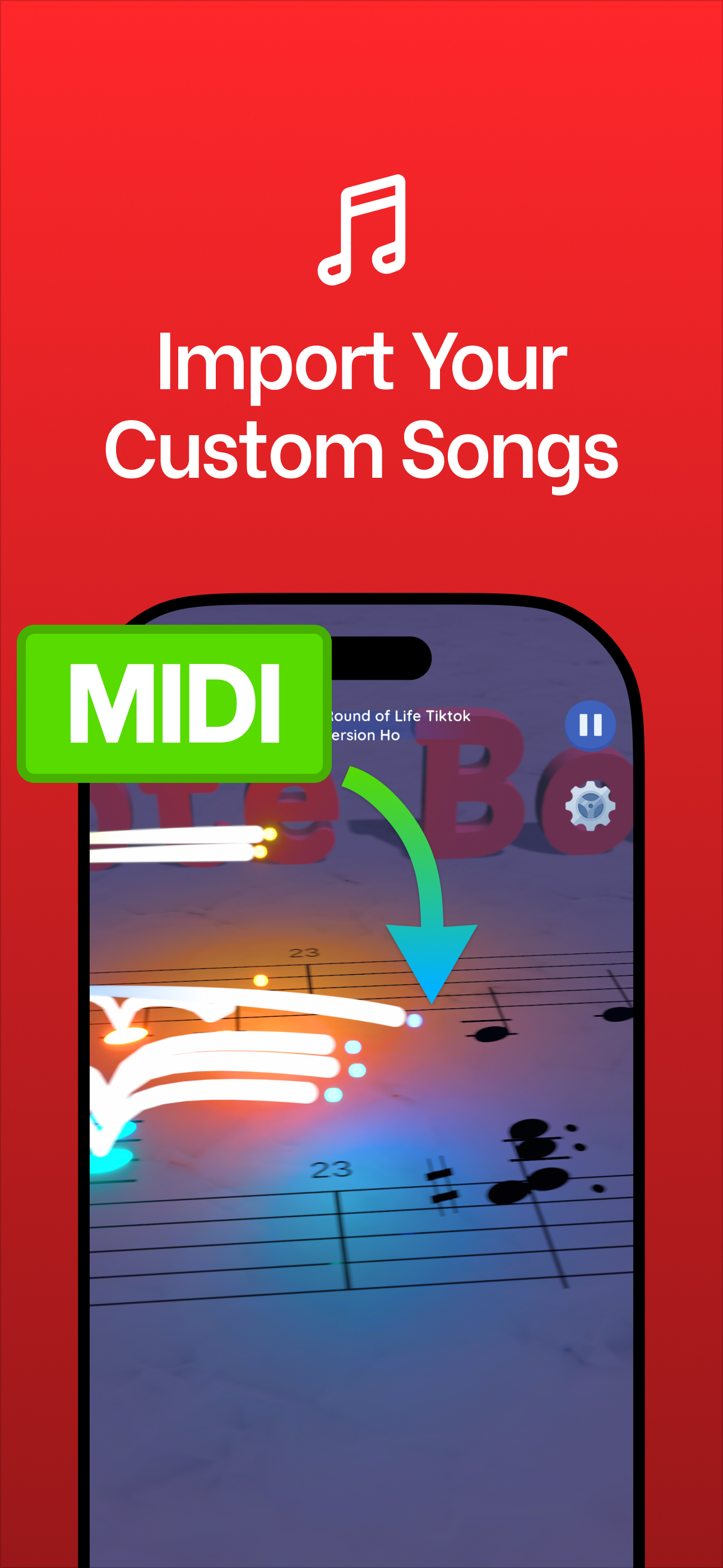
To play these in Note Bounce, import a MIDI file to build a custom level; the balls then land on the real notes in time, so you read the carol as it plays.
- Find a source. The Mutopia Project has free public-domain scores, many with MIDI files. Or type the melody into a notation program such as MuseScore and export a MIDI yourself.
- Check the license. A traditional melody is public domain, but someone's new arrangement may not be.
- Start with the melody only. If a MIDI has several tracks, a melody-only file is easier to read.
- Import it and play. Name each note out loud as the ball lands, then try again without speaking.
Short traditional lyrics, like "Jingle bells, jingle bells", are fine to sing along with. Don't use lyrics or MIDIs of modern holiday songs; those are under copyright.
Once you can read a carol, you might want a festive clip to share. Marble Music (formerly Beat Bounce) turns MIDI files into bouncing-marble music videos where the marble lands on every note, and its free MIDI library includes Dance of the Sugar Plum Fairy and Carol of the Bells. Keep Carol of the Bells instrumental: the 1914 melody is public domain, but the English lyrics are not. For more on that piece, see reading the Carol of the Bells ostinato.
A December reading plan
Pick one song per week, in the order above, starting in late November. Spend the first few days reading it slowly, then try it at full speed by the weekend. If a song takes longer, stay on it; the order matters more than the pace.
Each week, import that song's MIDI into Note Bounce as a custom level and read it there too. Balls bounce onto the real sheet music in time, so you see each note as you hear it, which is a quick way to check the rhythm you counted on paper.
Frequently asked questions
What is the easiest Christmas song to play on piano?
Jingle Bells is usually the easiest to read, because its chorus repeats the same note many times and moves by small steps. Most beginners can read the chorus after a few run-throughs.
Are Christmas carols copyright free?
Traditional carols such as Jingle Bells, Silent Night and Deck the Halls are old enough to be in the public domain. Modern holiday songs, new lyrics and new arrangements of old carols may still be under copyright, so check the source of any score or MIDI you use.

Get Note Bounce
Learn to read sheet music while you play. Free on iOS, Android and Steam.